Six Bins and a Loose Screw: A Hardware-Aisle Mystery With a Shelf Life
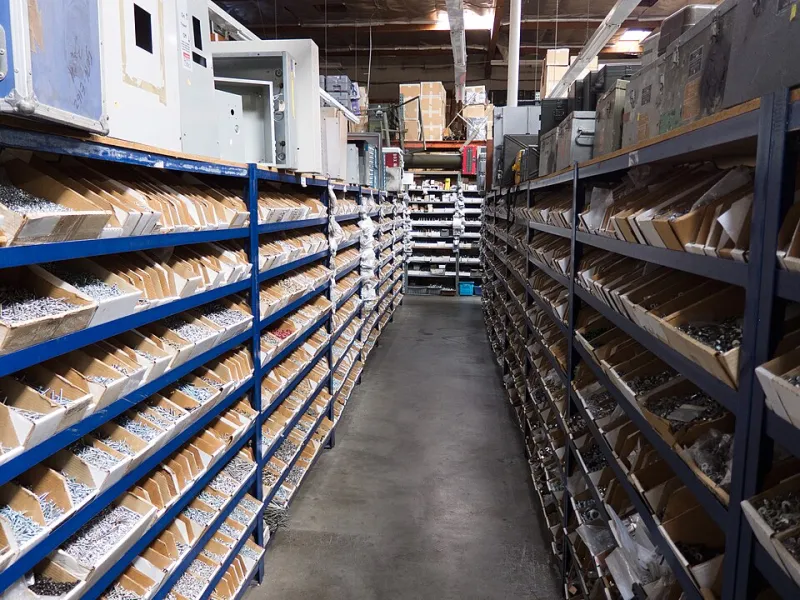
Photo: Jeff Keyzer from Seattle, WA, USA, CC BY-SA 2.0, via Wikimedia Commons
You do not need to buy a drill bit, flag down an orange-vested employee, or pretend to know what a lag bolt is. You need to solve the junk drawer. Specifically, you need to figure out what the previous owner of three small hardware artifacts was trying to build before they gave up and shoved everything into a ziplock bag.
The setting is the fastener aisle of any big-box hardware store or earnest local Ace. The lighting is fluorescent. The bins are labeled like they are mildly disappointed in you. And somewhere in the next six bins is the answer to a tiny, extremely low-stakes mystery.
The Evidence Bag: Three Clues From Someone’s Bad Afternoon
You are holding three things. Do not tighten anything. This is a puzzle, not a home-improvement project.
Artifact A: the loose screw. It is a wood screw—coarse threads, pointy tip, no nut required. The head is stamped with a tiny “8,” and the screw is about an inch and a quarter long. It looks slightly chewed, like it had a rough encounter with a driver bit.
Artifact B: the mismatched bracket. You have two corner braces, painted the same color, but they are not a pair. One is a 3-inch corner brace. The other is a 2-inch corner brace. Only one of them matches the paint chip clue. The other is a decoy, or possibly evidence of a previous failed trip.
Artifact C: the paint chip. On the back, in pencil: “2 7/8” and, underneath that, “32.” There is also a coffee ring and the word “cat?” written in a different handwriting. This is either a clue or someone’s grocery list. In our experience, it is both.
The Six Bins: Meet Your Suspects
Aisle 14, bins one through six. Each bin has a little size chart, and each chart is about to become your new best friend.
- Bin 1: Wood screws, #6 x ¾ inch.
- Bin 2: Wood screws, #8 x 1¼ inch.
- Bin 3: Wood screws, #10 x 2 inch.
- Bin 4: Machine screws, ¼-20 x 1 inch.
- Bin 5: Corner braces, 3 inch. Size chart notes a 2 7/8-inch hole spacing.
- Bin 6: Corner braces, 2 inch. Size chart notes a 1 7/8-inch hole spacing.
That is the whole game board. You do not need to open a single plastic bag. You just need to read, compare, and resist the urge to organize the bins alphabetically.
Clue 1: The Screw Is Coarse, Pointy, and a Little Dramatic
Start with Artifact A. The screw has coarse threads and a pointed tip. That means it is designed to bite into wood, not slide through a metal bracket and get capped with a nut. In hardware-speak, it is a wood screw. Bin 4 is out. Machine screws are blunt and usually paired with washers and nuts, like tiny formalwear.
Now look at the stamp: “8.” That is the gauge, not the length. The length is the 1¼ inch part. Bin 1 offers #6 x ¾ inch screws—too skinny, too short. Bin 3 offers #10 x 2 inch screws—too beefy, too long. Bin 2 is the only bin that matches both the gauge and the length: #8 x 1¼ inch wood screws.
So the screw belongs in Bin 2. This is not a purchase recommendation. It is a clue. Stay strong.
Clue 2: The Bracket Has a Size Chart and a Trust Issue
Next, the mismatched brackets. You have a 3-inch corner brace and a 2-inch corner brace, and only one of them fits the paint chip’s “2 7/8” measurement. The size chart in Bin 5 says the 3-inch brace has holes spaced 2 7/8 inches apart, center to center. The 2-inch brace in Bin 6 has holes spaced 1 7/8 inches apart.
The paint chip says “2 7/8.” That points to the 3-inch corner brace in Bin 5. The 2-inch brace is the odd one out—the hardware equivalent of bringing the wrong twin to a party.
Why does hole spacing matter? Because it tells you the bracket was meant to line up with something already drilled or measured. The person was not guessing. They had a plan, a pencil, and maybe a cat with opinions.
Clue 3: “32” Is Not a Screw Size
Finally, the number 32. It is not a gauge, a length, or a thread count. In this context, it is almost certainly a board length: 32 inches. Pair that with the 3-inch corner braces and the #8 x 1¼ inch wood screws, and a shape starts to emerge.
A 32-inch board. Two 3-inch corner braces. Screws short enough to attach the braces to a shelf without punching through the top. The 2 7/8 measurement is the hole spacing on the bracket, which means the person was lining up two braces at the ends of that 32-inch board. The mismatched 2-inch bracket was either a wrong purchase or a leftover from an earlier, smaller idea.
This is the moment the fluorescent lights feel a little more cinematic. You are not just standing in a hardware store. You are standing in the aftermath of someone’s Saturday afternoon.
The Reveal: A 32-Inch Cat Shelf, Probably
Put it all together: a 32-inch board, two 3-inch corner braces, #8 x 1¼ inch wood screws, and a paint chip with “cat?” on the back. The person was building a 32-inch shelf. Given the handwriting, the coffee ring, and the general energy of someone who has measured a window ledge twice, it was probably a cat shelf—a sunny perch for a cat who will ignore it in favor of a cardboard box.
The 2-inch bracket was a red herring. The loose screw was a spare. The paint chip was the blueprint. And you solved the whole thing without opening a single bag, downloading a single app, or asking a single employee where the “little screw things” are.
Your Prize: Nothing, and That Is the Point
There is no coupon at the end of this aisle. The reward is the quiet satisfaction of knowing that a stranger’s half-finished project had a logic to it. You may now return the screw to the junk drawer with a sense of purpose. Or, if you are feeling generous, place it in Bin 2 and walk away like a person who has their life together. You do not have to buy anything. You just have to appreciate that every hardware store is a museum of unfinished plans, and every bin is a tiny exhibit label.