The Sticker Residue Is a Witness: Five Thrift-Store Castoffs, One Previous Owner
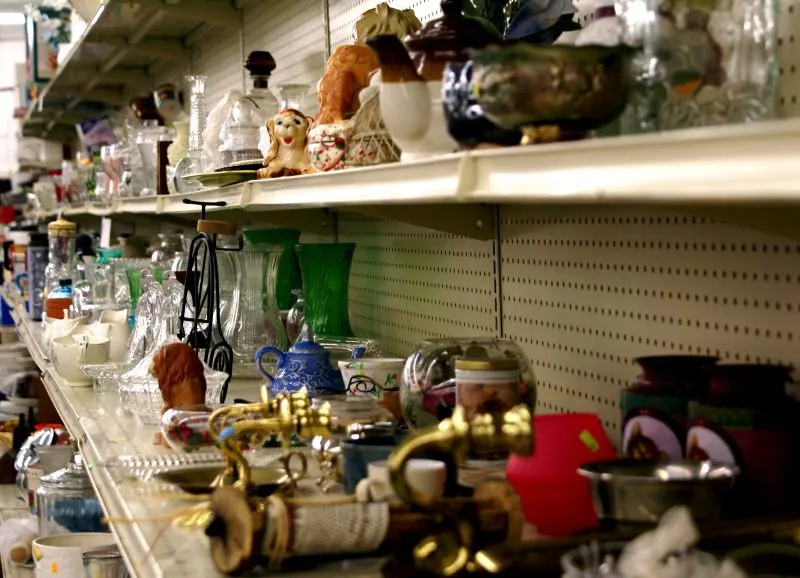
Photo: Valerie Everett, CC BY-SA 2.0, via Wikimedia Commons
Thrift stores are basically group projects with better lighting. Every castoff arrives with a price tag, a sticker scar, and a suspicious amount of wear on the left thumb. You do not need to buy anything to play this game. You need 20 minutes, five objects, and the willingness to look at a commemorative plate like it owes you money.
Welcome to the five-object provenance puzzle: a deduction game where the merchandise stays on the shelf and the previous owner takes shape in your imagination. Think of it as a logic grid with mothball energy.
First, the Thrift-Store Ground Rules
Before you become a castoff archaeologist, practice basic thrift etiquette. Pick up an item, inspect it, and put it back exactly where you found it. Do not rearrange a display to build your crime board. Do not block the aisle with a human-size wicker giraffe. If something is behind glass, admire it from a respectful distance or ask staff. And please do not narrate your deductions loudly near the donation desk, especially if your theory involves the words 'probable cat person.'
You are not buying. You are browsing with intent. There is a difference, and that difference is why you still have counter space.
The Five-Object Provenance Grid
Choose five objects from at least three different departments: housewares, clothing, crafts, media, kitchen gadgets, whatever your store offers. Avoid anything fragile, anything that requires a cart, and anything that makes a noise when you pick it up. Each object becomes a row on your logic grid. The columns are the five owner attributes you will deduce:
- Likely decade of original purchase
- Household role or life stage
- Hobby signal
- Pet probability
- Donation trigger
Now read the evidence. A price tag is not just a number. It is a color-coded sticker from the store's rotation system, a handwritten label, or a printed barcode with a date-like code. Sticker residue tells you whether an object sat in a garage or got peeled off a gift. Wear marks tell you where hands went: elbow shine, heel drag, ring marks on a mug handle, a thumb groove on a remote. Department codes and shelf placement tell you how the store categorized the thing, which is sometimes funnier than the thing itself.
Build clues in plain language. For example: 'The object with the heaviest heel wear did not come from housewares.' 'The item with a zoo sticker is either the fanny pack or the paperback.' 'The candle with no burn marks was donated in the same decade as the necktie.' Your grid does not need to be mathematically airtight. It needs to be fun enough that your friend argues with you about a bread maker.
Your Printable Scoring Sheet
Draw a 5x5 grid on the back of an old receipt. Write your five objects down the side and your five attributes across the top. Use a pencil, because your first theory about the ceramic frog will be wrong. Score 10 points for every attribute you solve, 5 bonus points for every clue you invent that makes someone say 'wait, that is actually a good point,' and 25 points for a one-sentence owner portrait that feels uncomfortably specific. Deduct 15 points if you accidentally buy the frog. You have lost the game but won a frog.
Three Ready-Made Case Files
No time to build your own? Steal one of these pre-loaded cases. Each uses five objects you can find in a typical US thrift store, and each points toward a plausible previous owner.
Case File 1: The Ceramic Frog and the Book Club Alibi
Objects: a ceramic frog with a chipped toe, a 1990s paperback thriller with a cracked spine and a grocery-list bookmark, a fanny pack with a sunscreen stain, an unlit jar candle, and a necktie with a faint knot crease.
Clues: the frog has a handwritten 'made by Grandma' sticker on the bottom. The paperback carries a library-sale stamp and penciled notes in the margins that say 'book club?' The fanny pack contains a folded zoo map from a decade ago. The candle has never been lit. The tie has a perfect knot crease but no other wear.
Most plausible owner: a retired elementary school teacher in her sixties who ran a mystery book club, took grandkids to the zoo, received candles she never burned, and kept one good tie for weddings and funerals. Donation trigger: downsizing to a condo with fewer shelves.
Case File 2: The Rollerblade Santa and the Accidental Minimalist
Objects: a Santa ornament on rollerblades, a stainless travel mug with initials, a VHS workout tape, a dog leash with a chewed handle, and a power strip labeled 'Xmas lights - DO NOT USE.'
Clues: the ornament has a tiny year sticker from the late 1990s. The travel mug bears a hospital volunteer sticker. The VHS tape is dusty but rewound. The leash has tooth marks near the clip. The power strip label is written in all caps, which is the universal font of someone who has been burned before.
Most plausible owner: a holiday enthusiast who volunteered at a hospital, owned a determined dog, and moved into an apartment where the Christmas lights finally defeated them. Donation trigger: a move that forced a minimalism reckoning.
Case File 3: The Bread Maker and the Suspiciously Neat Receipt
Objects: a bread maker with the manual, an apron with a flour handprint, a cookbook with one dog-eared page, mismatched measuring spoons, and a hardware-store receipt tucked inside the manual.
Clues: the bread maker looks barely used. The apron looks very used. The cookbook page is for beginner sourdough. The measuring spoons are a set of survivors from three different sets. The receipt is for paint and a drop cloth.
Most plausible owner: a hopeful home baker who attempted one ambitious loaf during a kitchen renovation, then donated the equipment before the paint dried. Donation trigger: a remodel, a realization, or both.
How to Win the Provenance Game
Play solo by writing a short owner profile before you check your grid. Play with a friend by taking turns revealing one clue at a time while the other guesses. The winner is whoever builds the most plausible portrait, not whoever is technically correct, because the previous owner is not here to confirm anything and the ceramic frog is not talking.
The real prize is that you turned a 20-minute browse into a tiny mystery. The sticker residue was a witness. The wear marks were a timeline. And the price tag, for once, knew exactly where it had been.